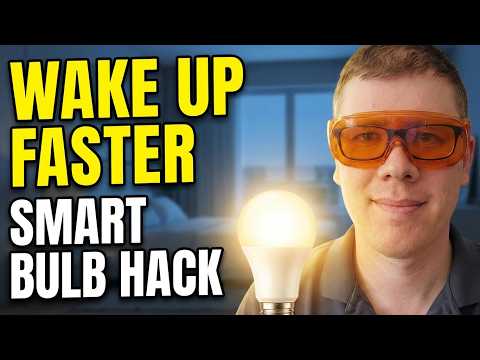
Dark mornings making it hard to wake up? Here’s a simple, affordable setup that helps.
Now that BC has remained on permanent daylight time, winter mornings in Vancouver are going to be darker than ever. Some days it’ll still be dark at 8 or 9 a.m. In this video, I show how I use color smart bulbs in the bedroom to flood the room with cool, daylight-style light, right when I want to wake up.
In this video:
0:00 Why fall and winter mornings feel so dark
1:00 Vancouver and permanent daylight time
1:38 What to look for in a smart bulb
2:26 Why you need two or three lamps, not one
2:54 Philips Hue vs Kasa by TP-Link
3:28 How to program your bulbs for wake-up
4:15 How morning light helps you wake up
5:02 Affordable options (and why I skip WiZ)
5:47 Light therapy lamps
6:32 Blue-blocking glasses in the evening
Bulbs I mention:
Philips Hue full-colour bulbs (Zigbee, very reliable, pricier)
Kasa smart bulbs by TP-Link (Wi-Fi, no hub needed, affordable)
The glasses I wear in the evening are Uvex Ultra-spec blue blocking glasses, which block nearly all blue light.
What do you do to get through the winter blues? If you’ve found a smart bulb brand that works well, let me know in the comments.
Full transcript and article: geoffmobile.com/blog/how-to-use-smart-light-bulbs-to-wake-up-faster-in-the-morning
Subscribe for more tips: youtube.com/geoffmobile
I’m Geoff from geoffmobile.com
Thanks for watching!
Video Topics:
Dark Winter Mornings? Use Smart Bulbs as a Sunrise Alarm
Beat the Winter Blues with Smart Light Bulbs
Vancouver’s Darker Mornings: A Cheap Smart Bulb Fix
How I Wake Up to “Daylight” When It’s Still Dark Outside
Smart Bulbs vs Dark Mornings: Hue, Kasa and Blue-Blocking Glasses

Video Transcript
Hi everyone on YouTube. This is Geoff from geoffmobile.com.
As we get into the rainier, snowier season of fall and winter, you may notice that it gets a lot darker in the mornings and in the evenings. When you wake up in the morning, it may still be dim or dark outside. In the early evening it starts getting dark a lot sooner as the days get shorter, and you may not have very much light in the evening.
Many people start feeling a bit of seasonal depression or lower energy because of the lack of natural daylight, especially when they wake up in the morning. You may be used to getting that burst of bright sunlight as soon as you wake up and open the curtain. Now, when you open the curtain, you’ll find that it’s quite dim, and maybe no light comes in at all.
This is especially true in areas such as ours. We’re in Vancouver, Canada, which is one of the places that decided not to switch the clocks back to standard time. We’re now on permanent daylight time, GMT minus 7 instead of GMT minus 8. That means it’s even darker in the morning, because we’re no longer switching our clocks back an hour.
In any case, I wanted to propose something you can do to ameliorate, or slightly improve, this lack of light in the morning.
Smart light bulbs
There are quite inexpensive smart light bulbs from many different brands. The ones you should be looking for are full-spectrum colour bulbs that can go anywhere from a bright, blue-tinged daylight (a very cool white) all the way to warm white, or even a pure red setting.
These smart bulbs generally hook up with your smart home, so if you’re using Google Home or Apple HomeKit, bulbs from different companies will be able to integrate with your home system. Many of them also have their own apps that let you set timers and choose the exact colour to come on at certain times.
You’ll probably want at least two or three lamps for your bedroom, with one of these smart bulbs in each. One lamp alone won’t produce enough lumens. It will be the right frequency, but it won’t be enough light. In our bedroom, we have two tableside lamps, one on either side of the bed, and they both have high-end Hue full-colour-spectrum bulbs.
Hue by Philips is the most expensive smart bulb system, but it’s very high quality. It uses Zigbee and works extremely reliably. I’ve experimented with cheaper models too. The other one I recommend is Kasa, made by TP-Link. They’re also quite good and reliable, they can be programmed to come on at certain times, and they use Wi-Fi rather than a special hub.
How to set them up
Get some smart bulbs, put them in your bedroom, and program them to come on at the time you want to wake up. Set them to a cool white or daylight colour temperature. You don’t want red, and you don’t want warm white. You want the coolest daylight setting, which is more of a blue-tinged white light.
You want those bulbs to come on right at the time you want to wake up. Some of them will let you fade in gradually over a minute, or you can have them pop straight on at full 100% brightness with the daylight or cool white setting.
The idea is that when you wake up in the morning, the lights come on and trigger your body to start reducing melatonin, a hormone that makes you sleepy. You’ll start feeling more awake, even if it’s still dark outside.
This tip matters a lot for places like Vancouver, BC, which didn’t switch the clocks back at the end of daylight saving time. We’re going to get some very dark mornings. At certain points in the winter, it may still be quite dark outside at 8 or 9 in the morning. By controlling the lighting in your home with smart bulbs, you can hopefully reduce the problem of not getting that bright daylight in the morning.
These bulbs are much more affordable than they used to be. The Hue colour bulbs are still quite expensive, but the Kasa bulbs are very affordable, and you can get them on Amazon. I don’t recommend the WiZ bulbs. They’re also made by Philips, but the quality of the system and the software is really poor, and half the time they never worked for me. I did find the Kasa bulbs from TP-Link quite reliable.
There are many other smart bulb brands you can try, maybe even cheaper ones. If you find one that works for you, please leave it in the comments below. How do you manage to battle the winter blues and the lack of light?
Light therapy lamps
If you want a more complete solution, you may want to look into light therapy lamps, which are clinically shown to reduce seasonal depression by shining very bright daylight-type light in your face. If you have the time to do that, you can set one up right next to your bed on a timer so it comes on when you want to wake up.
You can get a similar effect with these smart bulbs, but I definitely recommend having at least two or three in your bedroom so you have enough lumen output to make a difference.
Blue-blocking glasses in the evening
You may notice that I’m wearing these orange or yellow-tinted glasses. These are special glasses used in science labs that block 99.9% of blue light. I typically put them on in the evening around 9:00 p.m. When my body isn’t seeing any blue light in the evening, it helps me produce more melatonin over the evening hours, so by bedtime I naturally feel a bit more sleepy.
That’s another thing you can do to reduce the impact of using computers or phones at night. These glasses are Uvex Ultra-spec, and they’re designed to eliminate a lot of blue light. Regular glasses from an optometrist with blue blocking or blue reduction aren’t going to be as effective, because they won’t block the whole blue spectrum. These ones block pretty much all of it.
Thanks for watching
That’s my video for today. I hope it was helpful. I’ll put a transcript and a little article below based on this discussion.
If you have any comments, suggestions, or tips, or if this works for you, please leave them in the comments below, and don’t forget to subscribe. My name is Geoff from geoffmobile.com (Geoff with a “G”). It’s great to connect with you and hear your thoughts. All the best, take care, and see you next time.
Related Posts:

How my Exercise Routine has changed in the pandemic – Toastmasters Table Topics on Zoom
Your Voice is an Instrument – Toastmasters Speech by Geoff Peters – Samsung Gear 360 in 4k
What is the best diet? – vlog from Geoffmobile
Art Show – Coast Resource Centre 2012 in Vancouver BC Canada
Zach Berman and Ryan Slater – Cofounders of The Juice Truck in Vancouver – Food Talks Volume 3